
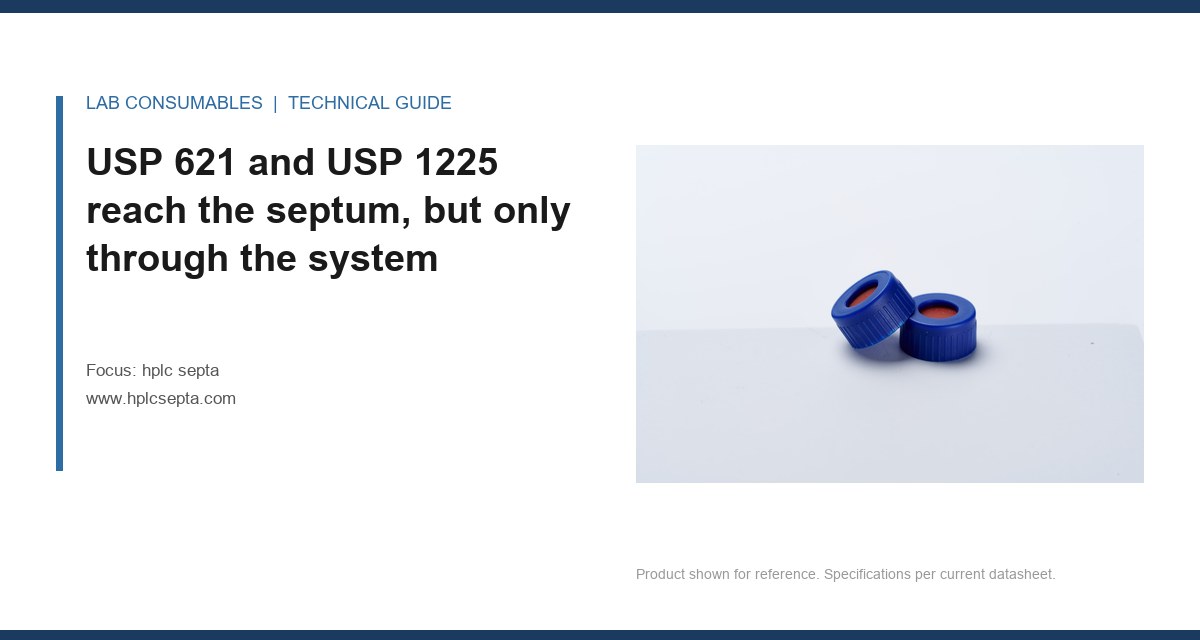
A 24-vial sequence failed system suitability at injection 17. Peak area RSD for the internal standard hit 4.8% against a 2.0% limit. The column, mobile phase, and detector all checked out. The problem was a septum that had been punctured 11 times beyond its rated life, and the USP method validation file had no specification covering that variable. The analyst had followed the method to the letter, and the method had a hole in it. That hole is what USP chapter requirements do and do not fill when it comes to USP requirements for hplc septa in a validated method.
USP 621 and USP 1225 reach the septum, but only through the system suitability gate
USP General Chapter <621> Chromatography is the chapter most people cite when they talk about HPLC method compliance. It sets the framework for system suitability: resolution, tailing factor, theoretical plates, and repeatability. What it does not do is name a septum. It does not specify a material, a Shore hardness, a puncture count, or a reseal pressure. What it does require is that the chromatographic system, as assembled, produce repeatable results within defined limits. The septum is part of that assembled system. When a septum fails mechanically, the failure shows up as an RSD excursion, a pressure anomaly, or a ghost peak. USP <621> does not care why the RSD went high. It just says the system is not suitable until it comes back down.
USP General Chapter <1225> Validation of Compendial Procedures is where the method validation file lives. It requires that you demonstrate precision, accuracy, linearity, range, and robustness. Robustness is the one that matters here. A robustness study is supposed to show that deliberate small variations in method parameters do not destroy the result. Flow rate plus or minus 0.1 mL/min, column temperature plus or minus 2°C, mobile phase pH plus or minus 0.2. The septum is rarely on that list. I have reviewed dozens of validation protocols, and I can count on one hand the number that included a septum variable. Most labs treat the septum as a consumable outside the method. That is the gap.
What USP actually requires in practice is narrower than most people think. It requires that your system suitability criteria be met every time you run the method. It requires that the method be validated as written. It does not require a septum-specific specification. That is left to the lab. And that is where a validated method either stays in control or drifts into out-of-spec investigations that nobody can explain.
The septum is a sample integrity component, not a column accessory
When I ran a consumables line, I saw the same mistake repeated across dozens of labs. They treated the septum as a commodity: same part number, same box, same drawer. They did not treat it as a component with a failure curve. A septum has a finite number of reliable piercings. That number depends on needle gauge, needle tip style, penetration depth, vial pressure, and the septum material. A PTFE/silicone septum in a 9 mm screw-top vial, pierced with a 22s gauge needle, will typically give you 8 to 12 reliable injections before the silicone core starts to tear. A 23s gauge needle with a bevel tip can push that to 15. A blunt-tip needle can cut it to 5. None of those numbers appear in USP. They appear in your method only if you put them there.
USP <621> does reference the injection system as part of the chromatographic system. It says the injection volume must be reproducible. A septum that reseals poorly after puncture allows partial sample loss or solvent evaporation between injections. The autosampler draws the programmed volume, but what actually reaches the column is less. The result is a low bias that drifts over a sequence. That is a precision failure, and it is a USP <621> failure. The septum caused it, but the chapter does not say so. It just says your RSD is out.
This is why I tell labs to write the septum into the method as a sample integrity variable, not as a column accessory. The column has a defined performance window: plate count, asymmetry, pressure. The septum needs the same treatment. If your method validation file does not state a maximum puncture count and a reseal verification, you have validated everything except the part that touches the sample first.
What USP <621> actually requires in practice for a septum
Here is the practical list. USP <621> requires that the system suitability test (SST) pass before and during the run. For a typical assay method, that means:
- Injection repeatability: RSD of peak area for five or six replicate injections of the standard, typically ≤1.0% for assay and ≤2.0% for impurities.
- Resolution between critical peak pairs: typically ≥2.0.
- Tailing factor: typically ≤2.0 for the analyte peak.
- Theoretical plates: method-specific, often ≥2000 for a 150 mm, 5 µm column.
None of these are septum specifications. But a septum that cores, leaks, or sheds particles can push any one of them out of range. A cored septum drops a silicone fragment into the vial. That fragment can partially block the needle on the next draw, causing a variable injection volume. RSD goes up. A septum that loses reseal integrity allows mobile phase vapor or sample solvent to escape, concentrating the sample over time. Later injections read higher than earlier ones. RSD goes up again. The SST catches the symptom. It does not identify the septum as the cause. That identification is the lab’s job.
USP <621> also requires that the SST be performed at defined intervals within the sequence. A common pattern is bracketing: SST at the start, SST at the end, and a check standard every 10 to 12 injections. If you run a 24-vial sequence and the septum on vial 17 fails, the check standard at injection 18 or 19 will catch it. The fix is not to rerun the SST. The fix is to replace the septum, or to have specified a septum with a higher puncture rating from the start.
USP <1225> robustness: the one place a septum variable belongs
USP <1225> says robustness is a measure of the method’s capacity to remain unaffected by small but deliberate variations in method parameters. It lists examples: mobile phase composition, pH, column temperature, flow rate. It does not list septum lot, septum material, or septum puncture count. But the principle applies. If changing the septum vendor or the septum lot changes the result, the method is not robust. That is a USP <1225> finding, even if the chapter never uses the word septum.
I have seen this play out in a real validation. A contract lab validated a method using a HPLC septa product with a specific silicone durometer. The method passed. Six months later, purchasing switched to a lower-cost septum from a different vendor. The new septum had the same dimensions and the same PTFE face, but the silicone core was softer, Shore A 40 instead of Shore A 50. The needle pierced more easily, which felt fine. But the softer core did not reseal as tightly after puncture. Sample solvent evaporated between injections. The RSD on the next sequence hit 3.1%. The method had not changed. The septum had. And because the validation file did not include a septum specification, the lab spent three days investigating columns, pumps, and detector lamps before someone checked the vial drawer.
The fix is simple. Add a septum variable to the robustness section of the validation protocol. Test two septum lots, or one lot at two puncture counts: fresh and at 80% of rated life. If the method passes both, you have demonstrated robustness. If it fails, you have found a real variable before it finds you in a production run.
What USP leaves to the lab’s own specification
USP does not specify septum dimensions. It does not specify material. It does not specify puncture count, reseal force, or extractables. Those are left to the lab, and that is a deliberate choice. USP chapters are written to be method-agnostic. A septum that works for a 10 µL injection of an aqueous buffer may not work for a 2 µL injection of a volatile organic. A septum that works at ambient temperature may fail at 4°C in a chilled autosampler. The lab has to define what works for its method.
Here is what a defensible septum specification looks like in a validated method. It does not need to be long. It needs to be specific.
The minimum septum specification for a validated HPLC method
- Dimensions: match the vial closure. For a 9 mm screw-top vial, the septum diameter is typically 9.0 mm ± 0.1 mm. For an 11 mm crimp-top, 11.0 mm ± 0.1 mm. Thickness matters too: 1.0 mm to 1.5 mm for standard applications, 0.9 mm for some low-volume inserts.
- Material: PTFE face, silicone core. PTFE thickness 0.25 mm to 0.50 mm. Silicone durometer Shore A 45 to 55 for standard needle gauges.
- Maximum puncture count: state it. For a 22s gauge needle, 10 punctures is a safe default. For a 23s gauge needle, 12 to 15. For a blunt-tip needle, 5.
- Reseal verification: after the maximum puncture count, the vial must hold no more than 0.5% weight loss over 24 hours at the method’s storage temperature. That is a simple gravimetric check.
- Extractables: if the method is for low-level impurities or LC-MS, require a certificate showing no detectable extractables above 10 ppb for the target analytes in the method solvent.
That is it. Four or five lines in the method. Most labs do not have even one of them. They have a part number and a reorder point. That is not a specification. That is a purchase order.
Field case 1: the cored septum that passed every SST
A QC lab running a dissolution assay for a generic tablet product saw a slow upward drift in peak area over a 30-injection sequence. The drift was small, about 0.8% per 10 injections. The SST at the start passed. The check standard at injection 15 passed. The final SST passed. The method was fine by USP <621>. But the dissolution profile for the last six vessels read 2 to 3% higher than the first six. That is enough to fail a content uniformity comparison.
The measurement that found it was a simple vial weight check. The analyst weighed 10 vials before the sequence and again after. The vials that had been punctured 8 or more times showed an average weight loss of 0.9%. The vials punctured fewer than 5 times showed 0.1%. The septum was a single-layer silicone, no PTFE face. It resealed poorly after repeated punctures, and the sample solvent, a 60:40 methanol-water mix, evaporated slowly. The fix was to switch to a PTFE/silicone septum with a 0.25 mm PTFE face and to set a maximum puncture count of 8 in the method. The drift disappeared. The SST never caught it because the drift was linear and small enough to stay inside the bracketing windows.
That is the key point. USP <621> catches gross failures. It does not catch slow, systematic drift that stays inside the SST limits. That drift is a method robustness problem, and it belongs to USP <1225> territory. The lab has to own it.
Field case 2: the septum that flaked under cryogenic autosampler conditions
A research lab running a peptide mapping method stored samples at 4°C in a chilled autosampler tray. The method used a 9 mm screw-top vial with a PTFE/silicone septum. After about six months, the lab started seeing intermittent ghost peaks in the gradient blank. The peaks were small, broad, and eluted late in the gradient. They were not from the column, the mobile phase, or the injection system. The measurement that identified the source was a blank injection from a vial that had been punctured 4 times and stored at 4°C for 48 hours. The ghost peaks appeared. A fresh vial from the same lot, punctured once, showed nothing.
The problem was the silicone core. At 4°C, the silicone became stiffer. Repeated puncturing at low temperature caused micro-fractures in the core, and tiny silicone particles shed into the sample. Those particles adsorbed sample components and released them slowly during the gradient. The fix was to switch to a septum rated for low-temperature use: a PTFE/silicone with a Shore A 35 durometer core, designed to stay flexible down to -40°C. The ghost peaks disappeared. The method file now includes a storage temperature range for the septum and a maximum puncture count of 6 at 4°C.
This case is specific to the septum, not to the column or the detector. It is exactly the kind of failure that USP chapters do not anticipate and that the lab has to cover in its own specification.
Decision checklist: is your septum specification USP-defensible?
If an inspector asks you to show that your septum choice does not compromise the validated method, here is what you need. If you can answer yes to all four, you are in good shape. If you cannot, fix the gap before the next audit.
| Requirement | What to have on file | Concrete threshold |
|---|---|---|
| Dimensions match the vial closure | Certificate of analysis for the septum lot | Diameter ±0.1 mm, thickness ±0.05 mm |
| Material is specified | Vendor datasheet with PTFE thickness and silicone durometer | PTFE 0.25–0.50 mm, Shore A 45–55 |
| Puncture count is defined | Method section on sample handling | 10 max for 22s gauge, 6 max at 4°C |
| Reseal is verified | Gravimetric test result after max punctures | ≤0.5% weight loss over 24 h |
| Extractables are checked | Vendor certificate or in-house test | ≤10 ppb for target analytes in method solvent |
This is not a USP table. USP does not publish one. It is the table I built after watching too many labs chase RSD failures into columns and pumps when the answer was sitting in the vial drawer.
Where the septum fits into a USP <1225> robustness study
If you are validating a method now, add one line to the robustness protocol: septum variable. Test two conditions. First, a fresh septum, punctured once. Second, a septum at 80% of its rated puncture count. Run the full SST and the assay on both. If the results differ by more than 2.0% relative, the method is not robust to septum wear. You have two choices: tighten the puncture count limit, or change the septum to one with a higher rating.
I have seen this test catch a problem that would have taken months to surface. A method for a light-sensitive compound used a clear glass vial with a PTFE/silicone septum. The robustness test showed that the assay result dropped by 3.5% when the septum was at 8 punctures versus 1 puncture. The cause was sample evaporation through the worn septum, concentrating the light-sensitive degradation product. The fix was a vial closure with a thicker PTFE face, 0.50 mm instead of 0.25 mm, and a maximum puncture count of 6. The method passed a full validation after that.
The septum robustness test costs one extra sequence. The alternative is a failed production run and a deviation investigation that costs ten times as much.
USP chapter list that actually touches the septum
For the record, here are the USP chapters that reach the septum, directly or indirectly, and what each one does and does not require.
- <621> Chromatography: sets SST requirements. Catches gross septum failures as RSD or resolution excursions. Does not name the septum.
- <1225> Validation of Compendial Procedures: requires robustness. The septum belongs in the robustness study as a deliberate variable. Does not name the septum.
- <1663> Assessment of Extractables Associated with Pharmaceutical Packaging/Delivery Systems: applies if the septum is part of the sample storage system. Requires extractables testing for the septum material in the method solvent. This is the one chapter that does name the closure system, even if it does not use the word septum specifically.
- <1664> Assessment of Drug Product Leachables: applies to leachables that migrate from the closure into the sample. Relevant for long-term storage studies.
That is the complete list. Four chapters. Two of them are indirect. Two of them are direct but rarely applied to HPLC septa because labs think of septa as consumables, not as packaging. The sample handling chain starts at the vial and the septum, and USP <1663> and <1664> are the chapters that say so.
What a defensible septum specification looks like in a validated method file
Here is the full text I recommend labs paste into their method, adapted to their specific conditions. It is short, it is concrete, and it closes the USP gap.
Sample handling and septum specification: Samples are stored in 9 mm screw-top vials with PTFE/silicone septa, PTFE face 0.25 mm to 0.50 mm, silicone core Shore A 45 to 55. Septum diameter 9.0 mm ± 0.1 mm. Maximum punctures per septum: 10 for 22s gauge needles, 6 for storage at 4°C. After the maximum puncture count, the vial must show ≤0.5% weight loss over 24 hours at the method storage temperature. Septum lots must have a certificate of analysis showing no extractables above 10 ppb for the target analytes in the method solvent. A septum robustness test is performed during validation: assay results at 1 puncture and at 80% of maximum punctures must agree within 2.0% relative.
That paragraph is not in USP. It is what USP leaves to you. If you have it, an inspector can see that you have controlled the variable. If you do not, you are relying on luck and vendor consistency.
Troubleshooting checklist: septum-related failures that USP will blame on your method
When an SST fails and the column checks out, run this list before you touch the pump.
- RSD above 2.0% on the standard: check the puncture count on the standard vial. If it is above 10, replace the septum and rerun. If RSD drops, the septum was the cause.
- Ghost peaks in the blank: run a blank from a fresh vial and a blank from a vial punctured 6 or more times. If the ghost peaks appear only in the worn vial, you have septum shedding.
- Low peak area drift over the sequence: weigh vials before and after the sequence. Weight loss above 0.5% indicates evaporation through a worn septum.
- Pressure spikes during injection: a cored septum can leave a silicone fragment in the needle seat. Check the needle seat and the injection port for particles.
- Carryover above 0.1%: a septum that does not reseal can allow vapor-phase carryover between vials. Replace the septum and reduce the puncture count limit.
Each of these symptoms can also come from other sources. But if the septum is the last thing you check, you will waste a day on the column and the detector before you find it. I have done that. It is not a good use of a shift.
The vendor datasheet is not a USP document, but it is evidence
A septum datasheet from a reputable vendor will list dimensions, material composition, durometer, temperature range, and sometimes puncture resistance. It is not a USP document. USP does not review or approve septum vendors. But in an audit, the datasheet is evidence that you selected a component with known properties. If your method file references the datasheet and includes the septum specification above, you have closed the loop.
What the datasheet will not tell you is how the septum behaves in your specific method solvent at your specific temperature with your specific needle. That is your data to generate. The chromatography consumables vendors can give you material compatibility charts. They cannot run your method for you. The analytical testing that matters is the septum robustness test in your own validation protocol.
The same logic applies to the vial itself. A HPLC vial and its septum are a matched system. The closure torque matters. A 9 mm screw-top cap tightened to 0.25 to 0.35 N·m will seat the septum correctly. Over-tighten to 0.5 N·m and you can deform the septum, reducing its effective puncture life. Under-tighten to 0.15 N·m and you lose the seal. That torque value belongs in the method too. Most analysts tighten by feel, and feel varies by analyst. That is a variable USP does not control and your method should.
What USP <1663> means for extractables from HPLC septa
USP <1663> is the chapter most labs ignore when it comes to HPLC septa. It covers extractables from packaging and delivery systems. An HPLC septum is a delivery system component. It contacts the sample solvent, sometimes for hours or days. If the method is for low-level impurities, degradation products, or LC-MS, the septum can contribute extractables that interfere with the analysis.
The practical requirement is simple. Run a blank extraction of the septum in the method solvent for 24 hours at the method storage temperature. Analyze the extract by the method. If you see peaks above 10 ppb for the target analytes, the septum is not suitable. If the method is for high-concentration assay work, the threshold can be higher. For trace analysis, it cannot.
I have seen a septum lot contribute a siloxane peak at m/z 73 in an LC-MS method. The peak was small, but it co-eluted with a low-level impurity at 0.05% area. The method was for a pharmaceutical impurity profile with a reporting threshold of 0.05%. The septum peak pushed the impurity result over the threshold. The fix was a septum with a 0.50 mm PTFE face and a silicone core that had been post-cured to reduce residual siloxanes. The extractables test in the method file now catches that before it reaches a sequence.
This is the part of USP compliance that most labs skip because it is not in <621>. But <1663> is a USP chapter, and it applies. If you are running a validated method for a regulated product, the septum is part of the sample contact surface. Treat it that way.
The decision rule
USP <621> and <1225> do not name the septum, but they reach it through system suitability and robustness. USP <1663> reaches it directly through extractables. What USP leaves to the lab is the specification: dimensions, material, puncture count, reseal, and extractables. If your method file contains those five numbers, you have a USP-defensible septum. If it contains only a part number, you have a variable you are not controlling. The decision is not whether to write a septum specification. It is whether you want to find the failure in validation or in a production sequence. Write the specification. Test the robustness. Set the puncture limit. That is the whole job.
References & further reading
Related resources from our lab consumables network:
- Hplc Septa at hplcsepta.com
- Vial Closures at vialsclosures.com
- Analytical Testing at testinganalytical.com
- Hplc Vial at vialforhplc.com
External references and standards: