
We rejected a lot of septa last year on a single defect: 0.7 mm of off-center needle penetration on a 9 mm natural-rubber disc, measured across 30 vials pulled from one lot. The vendor’s COA said “within specification.” Their spec sheet had no concentricity tolerance at all. That is the whole problem with supplier audits in this category. Most septa vendors will pass any checklist you build from their own marketing material, and still ship you a lot that cores at 40 injections instead of 120. A working hplc septa supplier audit checklist has to test the things the vendor cannot fake: process capability, incoming material control, and the paper trail that connects a batch of rubber to the vials on your autosampler.
What follows is the checklist I actually run, in the order I run it, with the evidence I ask for before anyone visits a plant and the scoring that decides whether a vendor stays on the approved list.
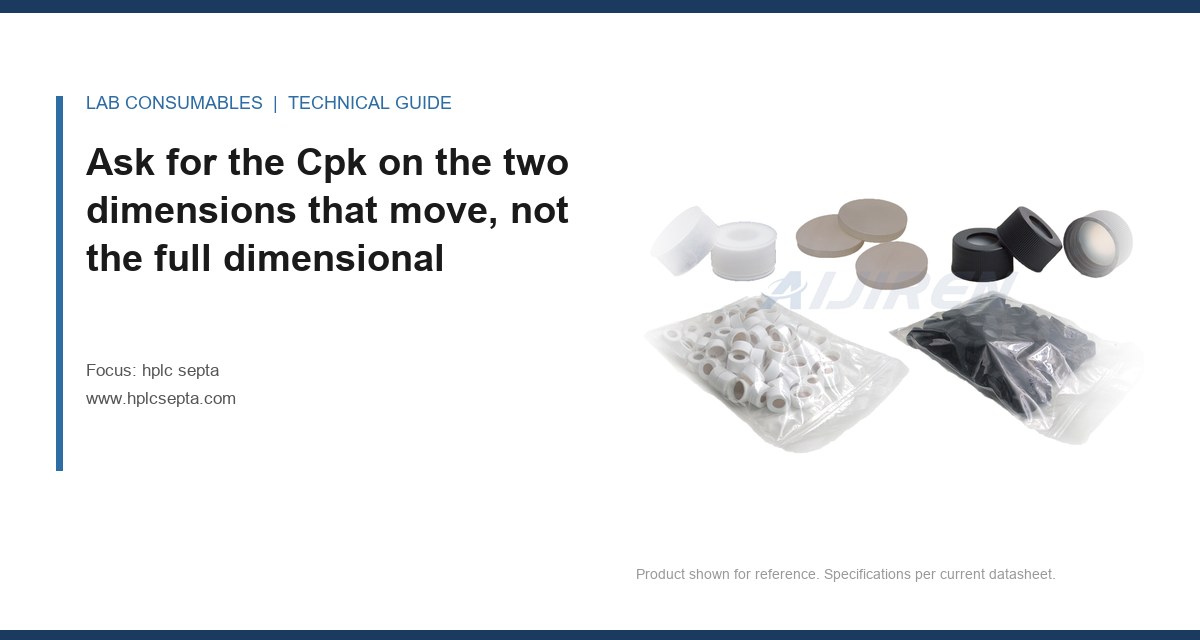
Ask for the Cpk on the two dimensions that move, not the full dimensional report
A full dimensional report on a septum is mostly noise. Thickness and diameter are easy to hold and rarely cause failures. The dimensions that actually drift between lots are penetration concentricity (needle entry relative to disc center) and seal ridge height on the underside of a lined septum. Ask for process capability on those two, computed from at least 30 consecutive parts per shift, over three lots.
What you want to see: Cpk ≥ 1.33 on concentricity against a tolerance no wider than ±0.25 mm, and Cpk ≥ 1.33 on ridge height against ±0.05 mm. If the vendor cannot produce a Cpk because they only do a first-article inspection, that is your answer. First-article inspection proves the tooling was correct on the day it was qualified. It says nothing about part 400,000.
I have seen a supplier quote “±0.1 mm concentricity” and then, when pressed, admit the number came from a single molded cavity on a single day. The same part number from the same vendor, run on a different press, drifted to 0.4 mm off-center. On a 9 mm septum in a 2 mL HPLC vial, that much offset puts the needle path close enough to the crimp ring that coring rate triples. The Cpk request is what surfaces that.
The evidence to request in advance, before any call
- Control plan naming the characteristic, the sample size, the frequency, and the reaction plan when a point goes out of control. A control plan with no reaction plan is a wish list.
- Three consecutive lot Cpk reports on concentricity and ridge height, with raw measurement data, not just the summary statistic.
- Gage R&R on the concentricity measurement itself. If the measurement system contributes more than 30% of the tolerance, the Cpk is fiction.
- Compound formulation sheet with cure system and any post-cure, plus the supplier’s own incoming COA for the raw elastomer.
Incoming material control is where most septa vendors are thin
Septa are molded from compounded elastomer, and the properties that decide seal performance (compression set, hardness, extractables) come from the compound, not the mold. A vendor who buys pre-compounded rubber and molds it has almost no control over lot-to-lot variation in the thing that matters. So the audit question is not “do you inspect incoming material” but “what do you measure on incoming compound, and what do you do when it is out of band.”
Look for durometer (Shore A, typically 45 to 55 for silicone, 55 to 65 for natural rubber and EPDM used in septa), compression set after 22 hours at 100 °C (want under 25% for a resealing septum), and cure state by rheometer or DSC. A vendor that only checks durometer is checking the least predictive property. Compression set is the one that predicts whether the septum reseals after 100 punctures or leaks at injection 60.
Ask to see a rejected incoming lot. Every real manufacturer has one. If the answer is “we have never rejected incoming material,” either they are not testing or they are not telling you. Both are disqualifying.
The formulation question that separates compounders from molders
If the vendor formulates their own compound, ask for the change-control procedure on formulation. Any change to cure package, filler loading, or post-cure schedule is a new material and needs a re-qualification against your method, not just an internal sign-off. I want a written commitment that formulation changes trigger a customer notification with 90 days notice and a qualification sample. Vendors who mold someone else’s compound cannot make that commitment, and that is fine, but they should be able to name the compounder and pass through the compounder’s change notices.
Traceability has to reach the compound batch, not stop at the molding lot
Every septum vendor prints a lot number on the bag. The audit question is what that number resolves to. I want to be able to take a lot number and walk backward to: molding date and press, compound batch, raw elastomer supplier lot, and the incoming inspection record for that compound batch. If the chain breaks at the compound batch, a bleed or coring complaint becomes untraceable and the vendor’s only response is “send it back.”
This matters more than it sounds. When a customer reports elevated extractables in a analytical testing run, the first thing I do is pull the septum lot and check whether the compound batch changed. If the vendor cannot supply that link, I am reduced to guessing, and guessing on a validated method is expensive.
The traceability chain for a molded consumable runs longer than the certificate that ships with it. Test it: pick a lot number from last year and ask the vendor to produce the full record. Time how long it takes. Under 24 hours is good. “We will get back to you” is a finding.
Score the vendor on four weighted categories, not a pass/fail list
A checklist that only produces pass/fail hides the difference between a vendor who is adequate and one who is strong. I score four categories, weighted, out of 100. Anything under 70 does not get on the approved list; between 70 and 84 is conditional with a re-audit at 12 months; 85 and above is approved.
| Category | Weight | What earns full marks | Typical score |
|---|---|---|---|
| Process capability | 35 | Cpk ≥ 1.33 on concentricity and ridge height, 3 lots, raw data, Gage R&R under 30% | 18 to 25 |
| Incoming material control | 25 | Compression set and cure state measured per lot, documented rejection history, formulation change control | 12 to 20 |
| Traceability | 20 | Full backward chain to compound batch in under 24 hours | 10 to 16 |
| Lot release testing | 20 | Functional puncture test at 100+ injections, extractables screen, AQL sampling with a real reject number | 10 to 17 |
Most vendors land between 50 and 75 on their first audit. The category that drags them down is almost always incoming material control, because most septa shops are molders, not compounders, and they have never been asked to demonstrate cure-state control.
What full marks looks like on lot release testing
Lot release should include a functional puncture test: a septum punctured 100 times with a real needle gauge at your autosampler’s penetration depth, then checked for coring (particle count) and seal integrity (pressure hold). I want the vendor’s own reject number on that test, and I want to see the AQL plan behind it. A sampling plan that only counts visual defects is not a release gate. It is a shipping form.
For lined septa, add an extractables screen by gravimetric or GC-MS at the vendor’s stated maximum temperature. Silicone septa rated to 200 °C and PTFE-faced septa rated to 260 °C should be tested at or near those limits, not at room temperature where nothing bleeds.
Field case: the lot that cored at 40 injections
Symptom. A method running 120 injections per batch started throwing intermittent “no peak” errors around injection 40 to 50. The autosampler was fine. The vials were fine. The septa were the variable.
Measurement. We pulled 30 septa from the suspect lot and measured concentricity on a vision system. Mean offset was 0.31 mm, with a max of 0.7 mm, against a nominal of 0.15 mm. We then ran a puncture test: coring particles appeared at a median of 42 injections, versus 110 on the previous lot. The compound was unchanged. The mold was unchanged. The difference was a new press operator running the cavity slightly off-center and a release test that only checked visual defects.
Fix. The vendor added concentricity to their in-process SPC with a 0.25 mm control limit and a reaction plan that quarantines the shift. We added a receiving inspection of 30 parts per lot on concentricity and a 100-injection puncture screen on one vial per lot. Reject rate on the next three lots was zero.
Field case: the “silicone” septum that was not
Symptom. A GC method with a 250 °C inlet started showing a rising baseline and ghost peaks after about 20 injections, on a septum lot that was supposedly the same silicone part number we had used for years.
Measurement. We ran a bleed test: heat the septum to 250 °C in a sealed headspace vial and look at the GC-MS profile. The suspect lot showed a siloxane pattern plus a phthalate peak that the reference lot did not have. Durometer came back at 58 Shore A against a spec of 48 to 52. The vendor had substituted a filled compound when their primary compound was short, and the incoming durometer check had a tolerance wide enough to let it through.
Fix. We tightened the durometer spec to ±2 Shore A, added a compression-set check on every incoming compound batch, and required a written notification for any compound substitution. The vendor’s own incoming control had been a single durometer reading per batch with a ±10 tolerance. That tolerance was the finding.
A receiving inspection that actually catches drift
Supplier audits predict problems. Receiving inspection catches the ones the audit missed. Run both. My receiving plan for septa:
- Sample size: 30 parts per lot for dimensional (concentricity, ridge height, thickness).
- Functional: one vial per lot through a 100-injection puncture screen on a representative needle gauge (typically 22s or 23 gauge for autosamplers).
- Chemical: extractables or bleed screen on the first lot of any new compound batch, and on any lot where the vendor’s COA shows a durometer shift of more than 2 Shore A.
- Documentation: COA must state compound batch, not just molding lot. Reject any COA that only has a molding lot number.
This plan takes about 90 minutes per lot and catches the failures that matter. If you are buying through a distributor rather than direct, the same plan applies, but the traceability question gets harder because the distributor may not hold the compound batch record. Ask the distributor to name the molder and confirm they can pass through the record set. If they cannot, buy direct or change distributor.
The questions that predict failure faster than any document
Documents can be prepared for an audit. A few questions cannot be rehearsed, and the answers tell you more than a control plan will.
- “What was your last customer complaint, and what did you change?” A vendor with no recent complaint is either perfect or not listening. The good answer names a specific failure mode and a specific corrective action.
- “Which press makes our part, and what else runs on it?” If your septum shares a press with a different compound, changeover control becomes a bleed risk. Ask for the changeover procedure and the purge scrap quantity.
- “What is your scrap rate on this part number?” Under 3% on a molded septum is suspiciously low unless the part is simple. 5 to 10% is normal for a lined septum. A vendor who claims 0.5% scrap is either not counting or not telling you.
- “When did you last change the mold, and what did you requalify?” Mold refurbishment changes cavity dimensions. A vendor who requalifies with a first-article inspection only has not requalified the process.
These four questions, asked in a 20-minute call, will sort a vendor list faster than a week of document review. The document review confirms what the call suggests.
The decision rule
Audit a septum vendor on process capability and incoming material control first, because those two categories predict nearly every failure you will see downstream. Require Cpk ≥ 1.33 on concentricity and ridge height from three consecutive lots, a documented compression-set and cure-state check on every incoming compound batch, and a traceability chain that reaches the compound batch in under 24 hours. Score the four categories, weight them, and set the approval line at 70. If a vendor cannot produce the Cpk data or the compound batch record, the audit is over regardless of price, because the failures those gaps hide will cost you more in reruns than the septa ever saved. For the parts themselves, start from a supplier that already publishes the capability data, and cross-check the vial and closure side of the system against the same standard at hplcsepta.com and vialsclosures.com.
References & further reading
Related resources from our lab consumables network:
- Hplc Septa at hplcsepta.com
- Vial Closures at vialsclosures.com
- Analytical Testing at testinganalytical.com
- Hplc Vial at vialforhplc.com
External references and standards: