
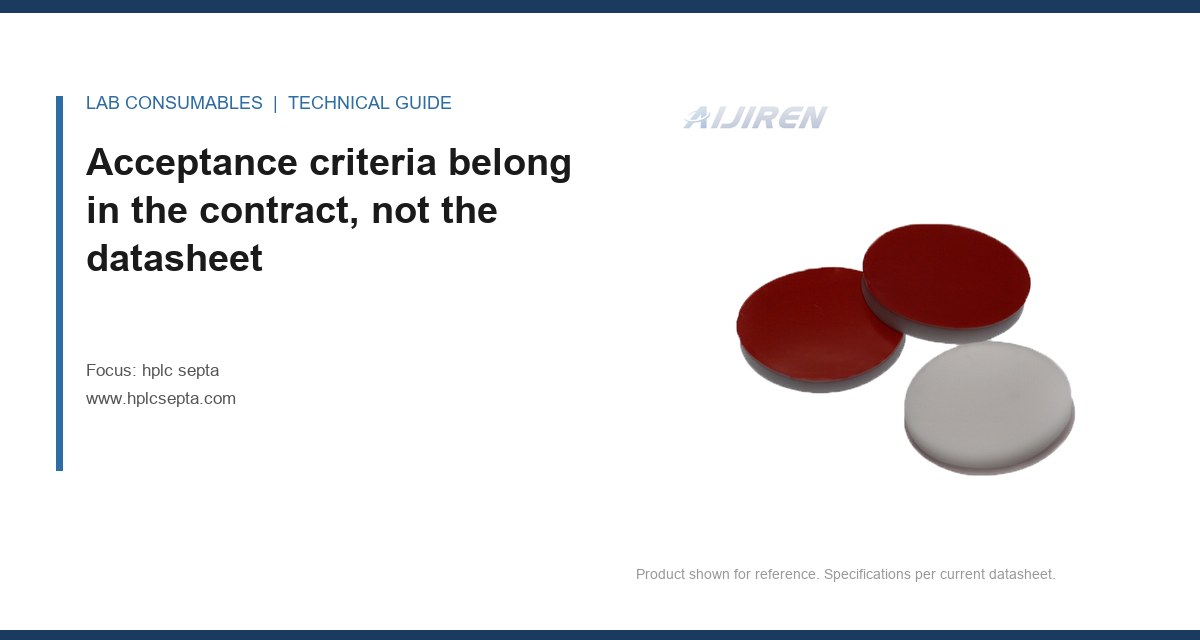
A 96-well run on a 1260 Infinity II died at injection 47 with a split peak on the internal standard and a 3.8% RSD on the bracketing calibrators. The septum was from a lot we had accepted eleven weeks earlier against a certificate that said nothing about lot-level puncture life. The supplier’s response was that the material met the drawing. That is the exact moment an hplc septa supply contract either has teeth or does not, and most of them do not, because the clauses that decide who pays for a failed run were never written into the purchase agreement in the first place.
What follows is the contract language I now insist on when sourcing HPLC septa in volume. It is not about price arithmetic or second-source planning. It is about acceptance criteria, latent defect windows, recall obligations, and the specific clauses that determine liability when a chromatographic run fails and the septum is the suspected cause.
A datasheet is a marketing document with a specification format. An acceptance criterion is a contractual test with a defined method, sample size, and pass/fail threshold. The gap between the two is where disputes live.
I require the contract to name the acceptance test method, the sampling plan, and the disposition of a failed lot. For septa, the practical acceptance set is short:
- Dimensional: critical dimensions measured per lot with a stated Cpk floor. For a 9 mm septum, the OD and the thickness at the center are the two that move. I set a minimum Cpk of 1.33 on both, measured on a 30-piece sample from the lot.
- Puncture life: a defined puncture count to a defined failure threshold. Failure is not “the needle goes through.” Failure is a pressure-decay or leak test after N punctures. I specify 100 punctures with a leak rate below a stated threshold at the operating inlet pressure.
- Extractables: a defined solvent, a defined time, a defined temperature, and a defined detection limit. A generic “low extractables” claim is not a criterion.
- Lot identity: the certificate must tie to the lot number on the bag, and the bag must tie to the shipment.
The contract should state that a lot failing any single acceptance criterion is rejected in full, at the supplier’s cost for freight and disposal. Partial acceptance of a failed lot is how marginal material enters your inventory and then your method.
Write the sampling plan with a number in it
An AQL plan that only counts visual defects is a shipping form. For septa, the acceptance plan needs an attribute sample for visible defects and a variables sample for the two dimensions that move. I use ISO 2859-1, general inspection level II, AQL 0.65 for visible defects, and a separate 30-piece variables sample for dimensional Cpk. The contract should name both plans and both sample sizes. If the supplier proposes a different plan, the negotiation is about the plan, not the price.
The latent defect window is the clause that actually costs money
Most purchase agreements give you 30 days from receipt to reject. That is fine for a box of vials. It is useless for a septum, because the failure mode is latent. A lot can pass incoming inspection and still fail at injection 400 in week nine, when the material has been in contact with your mobile phase and the coring has accumulated.
The latent defect window should be written as a time-and-usage clause, not a calendar clause. I negotiate a window of 12 months from the date of manufacture or 80% of the stated puncture life consumed, whichever comes first. The clock starts at the date of manufacture, not the date of receipt, because a supplier can ship you aged stock and the calendar window from receipt will not catch it.
Two things make this clause enforceable. First, the contract must define “latent defect” as a defect not discoverable by the acceptance test at incoming inspection. Second, it must state that the supplier bears the cost of the failed run, not just the cost of the septa. That second point is the one suppliers push back on hardest, and it is the one that matters.
What “cost of the failed run” should cover
I write the liability schedule as a defined list, not a vague “consequential damages” phrase that a supplier’s counsel will strike. The schedule should cover:
- Replacement of the septum lot at no charge.
- Cost of the samples consumed in the failed run, at a stated per-sample rate.
- Cost of the instrument time, at a stated hourly rate for the system.
- Cost of the investigation, capped at a stated number of labor hours.
- Cost of re-running the affected samples, at the same per-sample rate.
A supplier will accept a capped schedule. A supplier will not accept an open-ended consequential damages clause. The cap should be tied to something the supplier can underwrite, such as the value of the affected lot times a multiplier, and it should be stated as a number in the contract, not left to negotiation after the failure.
Lot recall obligations need a trigger and a clock
A recall clause without a trigger is a press release. The contract needs to define what constitutes a recall event, who can trigger it, and how fast the supplier must act.
I define a recall event as any of the following: a lot failing the acceptance test after shipment, a change in raw material source for the lot, a change in the molding tool or the press settings that produced the lot, or a field failure traceable to the lot. The trigger can come from either party. The clock starts when the trigger is documented.
The supplier’s obligations on a recall should be:
- Notify all customers who received the lot within 5 business days.
- Provide a written root cause within 30 days.
- Accept return of the lot at the supplier’s freight cost.
- Provide replacement material from a lot that has passed the acceptance test, with the test data attached.
I also require the supplier to disclose any change in the molding tool or the raw material source before the lot ships, not after. A tool change is a new part, even if the drawing number did not change. If the supplier cannot commit to pre-shipment disclosure of tool changes, the recall clause is the only protection you have, and it is a slow one.
Who pays when a run fails: the causation clause
This is the clause that decides most disputes, and it is almost never written well. When a run fails and the septum is suspected, the question is causation. The contract should define how causation is established, because otherwise the supplier will argue that the failure was the method, the mobile phase, the needle, or the operator.
I write a causation procedure into the contract. It has three steps:
- Retained sample: the supplier must retain a sample of every lot for 24 months from the date of manufacture, and make it available on request.
- Side-by-side test: the failed lot and a known-good lot are run under the same method, same instrument, same operator, same mobile phase, and the results are compared. If the failed lot shows a statistically significant difference in the defined acceptance metric (for example, a peak area RSD difference above a stated threshold), causation is established for the purpose of the liability schedule.
- Independent test: if the side-by-side is disputed, either party can require an independent laboratory test, with the cost borne by the losing party.
This procedure turns a shouting match into a test. It also puts a number on “statistically significant,” which is the part a supplier’s counsel will try to leave vague. I state the threshold in the contract: for example, a difference in peak area RSD of more than 1.5 percentage points between the two lots, on a defined number of injections, establishes causation.
Field case: the lot that passed incoming and failed at injection 400
Symptom: a 9 mm septum lot passed incoming dimensional inspection and the first 200 injections were clean. At injection 380 to 420, the internal standard peak area dropped 6% and the RSD climbed from 0.9% to 2.7%. The instrument was ruled out by swapping the column and the needle. The measurement that identified the cause was a puncture-life test on a retained sample from the same lot: the lot failed at 312 punctures against a stated life of 500, with visible coring at the needle track. The fix was a lot replacement under the latent defect window, and the contract clause that made it work was the retained-sample requirement. Without the retained sample, the supplier would have argued the lot was fine.
Change control: the clause that prevents the next failure
The most expensive septum failures are not defects. They are changes. A supplier changes the raw material source, the molding tool, or the press settings, and the part still meets the drawing. The failure shows up six weeks later in your method.
The contract should require written notice of any change to the following, before the first affected lot ships:
- Raw material source or grade.
- Molding tool or tool repair.
- Press settings outside a stated window.
- Manufacturing site.
- Any change to the acceptance test method.
I also require a first-article inspection for any changed lot, with the acceptance test data attached, before the lot is released to me. A supplier that cannot provide this is a supplier that will change the part without telling you.
The related question of who owns the mold is a separate article. The contract point here is narrower: if the supplier owns the mold, the change-control clause is your only protection, and it needs a notice requirement with a defined lead time. I use 30 days’ written notice for any change that affects the part.
Comparison: contract terms by risk tier
Not every septum purchase needs the same contract. I tier the terms by method criticality, and I write the tier into the purchase agreement so the buyer and the supplier are working from the same document.
| Term | Tier 1 (development, non-critical) | Tier 2 (routine QC) | Tier 3 (regulated, method-critical) |
|---|---|---|---|
| Acceptance test | Visual + dimensional AQL | Visual + dimensional Cpk 1.33 | Visual + dimensional Cpk 1.33 + puncture life + extractables |
| Latent defect window | 90 days from receipt | 6 months from manufacture | 12 months from manufacture or 80% of puncture life |
| Retained sample | Not required | 12 months | 24 months |
| Recall notice | 10 business days | 5 business days | 5 business days + root cause in 30 days |
| Change notice | After shipment | Before shipment | 30 days before shipment + first-article inspection |
| Liability cap | Lot value | Lot value x 3 | Lot value x 10, with defined cost schedule |
The tier is a decision, not a default. A Tier 3 term on a Tier 1 purchase will price the septum out of the market. A Tier 1 term on a Tier 3 purchase will cost you a failed run and a difficult conversation with your quality group.
The clauses that quietly decide liability
Beyond the headline terms, four clauses decide who pays in practice. They are easy to miss because they sit in the boilerplate.
Inspection period and deemed acceptance
Many agreements say that material is deemed accepted if not rejected within a stated period. That period should be long enough to run the acceptance test, which for septa means the puncture-life test, which takes days. I set the inspection period at 30 days from receipt for Tier 2 and 60 days for Tier 3, and I write that the period is extended by any acceptance test in progress.
Governing specification and order of precedence
When the purchase order, the drawing, the datasheet, and the acceptance test disagree, the contract must state which wins. I write the order of precedence as: the acceptance test first, then the drawing, then the purchase order, then the datasheet. The datasheet is last because it is the least specific document in the stack.
Warranty duration and remedy
The warranty should run for the latent defect window, not a fixed 12 months from shipment. The remedy should be replacement first, refund second, and the liability schedule third. A warranty that offers only replacement does not cover the cost of the failed run, which is the cost that matters.
Audit rights
For Tier 3, I require the right to audit the manufacturing site and the acceptance test records on 30 days’ notice, once per year. The audit right is what makes the change-control clause credible, because it is the mechanism by which you find out that the tool changed.
Field case: the recall that worked because the clause had a clock
Symptom: a Tier 3 customer reported peak area drift on a method that had been stable for two years. The drift started with a specific lot number. The measurement that identified the cause was the retained sample from the same lot: the extractables test showed a 2.4x increase in a siloxane peak against the previous lot, traced to a raw material source change the supplier had not disclosed. The fix was a recall under the contract clause: the supplier notified all customers within 5 business days, provided root cause in 22 days, and replaced the lot with material that passed the acceptance test. The clause that made it work was the pre-shipment change notice requirement, which the supplier had violated, and the recall clock, which forced a fast response.
What I put in the purchase agreement, in order
If you are rewriting a supply agreement for septa this quarter, the clauses that matter, in order of leverage, are: the acceptance test with its sampling plan and Cpk floor, the latent defect window measured from manufacture, the liability schedule with a stated cap, the recall trigger and clock, the change-control notice requirement, and the retained-sample obligation. The rest is boilerplate that your counsel will handle.
The decision rule is simple. If the contract cannot answer the question “who pays when a run fails and the septum is the cause” with a number and a procedure, it is not a supply contract for a method-critical consumable. It is a purchase order with a signature block. Write the acceptance test and the latent defect window first, because those two clauses decide every dispute that follows, and negotiate the rest around them. For the material and dimensional questions that sit underneath these clauses, the technical resources at Restek and the consumables documentation from Agilent and Thermo Fisher are worth reading before you write the specification, and the method context in EPA SW-846 is worth reading before you write the liability schedule.
One last point on the surrounding hardware. The septum does not fail alone. The vial closures and the HPLC vial are part of the same seal, and a closure that is out of tolerance will make a good septum look bad. If your acceptance test does not control the closure, the causation clause will be argued on the closure instead of the septum. And when the dispute goes to independent testing, the laboratory that runs the side-by-side needs to be accredited for the method, which is a question for your analytical testing partner before the failure, not after.
References & further reading
Related resources from our lab consumables network:
- Hplc Septa at hplcsepta.com
- Vial Closures at vialsclosures.com
- Analytical Testing at testinganalytical.com
- Hplc Vial at vialforhplc.com
External references and standards: